
As ChatGPT, Gemini, Claude, AI Overviews, and shopping assistants increasingly mediate product discovery, PDPs are no longer only documents to index or render. They are becoming inputs for machine interpretation.
That changes the problem.
A page can be technically crawlable, fully indexable, and still fail to preserve product meaning when interpreted by an LLM.
That was the starting point for this project.
I wanted to test whether ecommerce PDPs expose enough structured meaning for AI systems to reliably reconstruct the identity and constraints of a product.
Not summarize it.
Reconstruct it.
From Structured PDP Experiments to Semantic Reconstruction
This project did not start as a framework.
It started with a simpler experiment.
Previously, I tested how different LLMs interpreted ecommerce PDPs depending on how the content was structured. The experiment compared:
- traditional paragraph-heavy PDPs
- more structured PDPs
- PDPs with more explicit contextual signals
The interesting part was not whether the models could extract every single attribute.
They usually could not.
What stood out instead was that the models consistently extracted the attributes that carried the most semantic meaning.
For example, on technical products, models would often preserve:
- core specifications
- operating constraints
- major differentiators
- use-case signals
while ignoring or compressing secondary metadata.
That observation became important.
It suggested that semantic understanding is not necessarily about reproducing every field on the page. Instead, it is about whether the model can reconstruct the meaningful identity and constraints of the product.
In other words:
If an AI system consistently extracts the most important characteristics of a product, it is probably reconstructing the semantic meaning of that PDP reasonably well.
This framework was built directly from that premise.
Rather than evaluating whether a model copied all available metadata, the framework evaluates whether the important semantic signals survive the transition from PDP to AI interpretation.
The Core Question
The framework is based on a simple idea:
If an LLM consistently extracts the correct attributes and constraints from a PDP, the page is probably machine-readable in a meaningful way.
This is not about evaluating whether a model is “smart.” The evaluated object is the PDP itself.
The framework measures how much product meaning survives the transition from:
PDP → AI interpretation
I started calling this:
Semantic Fidelity
How faithfully can an AI system reconstruct the important characteristics of a product from the information available on the page
Why This Matters
Traditional SEO mostly evaluates crawlability, indexability, rendering, internal linking, metadata, and relevance signals. But AI-mediated discovery introduces another layer: extractability.
Can a language model identify the product correctly, preserve key constraints, reconstruct important attributes, avoid hallucinating missing information, and maintain the intended product positioning?
This becomes especially important in ecommerce.
If an AI system misunderstands features, then the PDP may technically “exist,” but semantically fail.
Choosing an example
For the first version of the framework, I wanted categories that were easy for anyone to understand, semantically very different from each other, and representative of different ecommerce content patterns.
For that reason, I used product pages from John Lewis across two categories: TVs and men’s T-shirts.
TVs are highly structured products.
Their meaning is heavily driven by specifications and technical constraints. Attributes such as screen technology, refresh rate, HDR support, gaming features, and operating system strongly influence how the product is interpreted.
Men’s T-shirts represent a very different challenge.
Their meaning is less technical and more descriptive. The important signals are things like composition, fit, sleeve type, neckline, and pattern. These attributes are often less standardized, less structured, and more context-dependent.
That contrast was intentional.
The goal was to test whether the framework could evaluate semantic reconstruction across highly structured technical commerce and softer descriptive commerce.
But the framework itself is not tied to John Lewis, TVs, or apparel.
The system is schema-driven. Changing the category schema changes the evaluation logic.
That means the same framework could theoretically evaluate laptops, sofas, industrial sensors, skincare products, automotive parts, kitchen appliances, sportswear, or almost any other ecommerce category.
The important part is defining which semantic attributes matter for that category and testing whether an AI system can reliably reconstruct them from the PDP.
The Framework
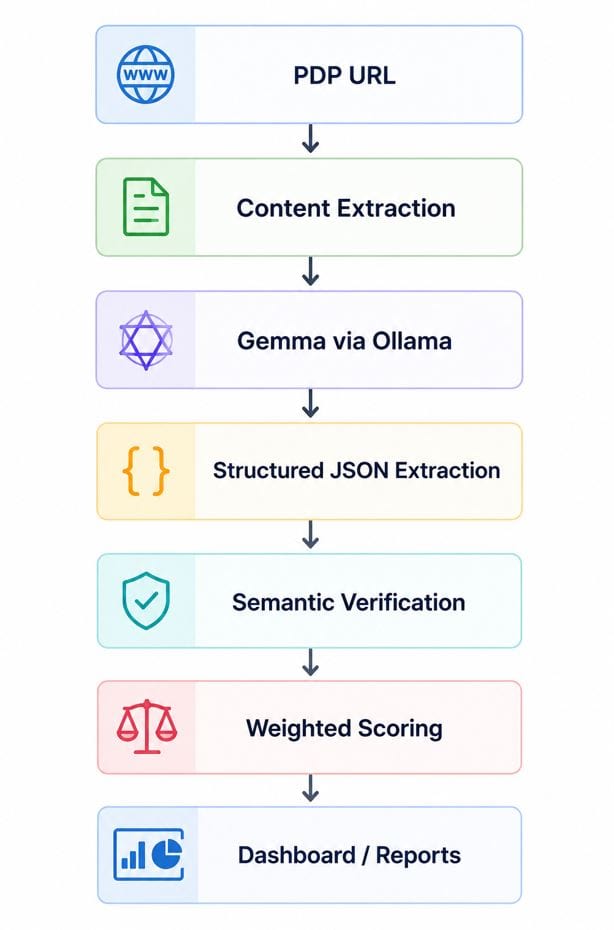
The project became a semantic evaluation pipeline for ecommerce product pages.
The system does not benchmark the quality of an LLM.
Instead, it evaluates whether a PDP provides enough clear information for an AI system to reconstruct the product reliably.
The framework currently runs locally using Python, Ollama, and Gemma. The architecture is intentionally modular and schema-driven.
The framework can be found in my Github account.
Step 1 — Product Categories and Semantic Schemas
The framework starts with two CSV files.
The first contains product URLs and their categories.
In my example:
url,category

https://example.com/tv1,tv
https://example.com/shirt1,tshirt
The second defines category-aware semantic schemas.
This is important.
Different product categories communicate meaning differently.
A TV and a men’s T-shirt should not be evaluated using the same semantic expectations.
For TVs, the framework focuses on attributes such as screen technology, resolution, refresh rate, gaming features, HDR support, and operating system. For T-shirts, it focuses on composition, fit, sleeve type, neckline, pattern, and brand.
Each field receives:
- a weight
- a required/optional state
- a field type
This allows the evaluator to score semantic importance instead of treating all metadata equally.
For example:
- missing “OLED” matters more than missing “country of origin”
- missing “100% cotton” matters more than missing washing instructions
That distinction is critical.
Step 2 — Fetching and Cleaning the PDP
The framework visits each URL and extracts readable page content.
It removes obvious noise such as scripts, styling, layout code, and navigation clutter.
The goal is not perfect rendering.
The goal is to approximate the product information an AI system can realistically interpret from the page.
The extracted content includes visible copy, specification tables, metadata, and structured data when available.
Step 3 — Structured Extraction Using Gemma
The cleaned PDP content is then sent to a local LLM through Ollama.
In this version, the default model is Gemma 4.
The model is instructed to avoid guessing, avoid inference, preserve constraints, return null when information is missing, and output structured JSON only.
Example TV extraction:
{
  "screen_technology": "OLED",
  "resolution": "4K",
  "refresh_rate": "120Hz",
  "gaming_features": [
    "VRR",
    "ALLM",
    "HDMI 2.1"]
}
The important part here is not whether the model generates fluent language. The important part is whether it preserves product meaning faithfully.
Step 4 — Semantic Verification Against Page Evidence
This is where the framework becomes more than a simple extraction script.
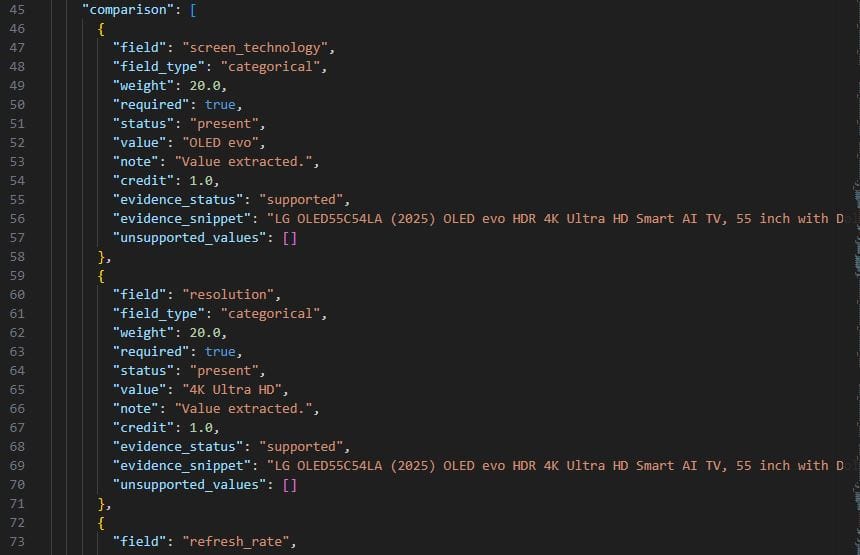
After the model returns structured data, the framework validates the extracted values against the original page evidence.
It checks whether the extracted attributes actually appear in visible text, metadata, structured data, or specification tables.
This helps separate:
- extracted information
- inferred information
- hallucinated information
A model may sound convincing while still introducing unsupported assumptions.
The framework attempts to measure reconstruction fidelity, not linguistic confidence.
Step 5 — Weighted Semantic Scoring
The system then calculates a weighted semantic fidelity score.
The scoring is not binary. It considers field importance, required versus optional attributes, missing values, unsupported extractions, hallucinations, and structural correctness.
Some fields carry more semantic importance than others.
The final score is intended to represent:
How much meaningful product information survived the path from PDP to AI interpretation.
What The Framework Is Actually Measuring
The framework measures whether a PDP preserves enough structured meaning for reliable reconstruction.
That is a narrow and practical problem and increasingly, it is an important one.
As AI systems become intermediaries between users and ecommerce platforms, PDPs may need to evolve from pages optimized for indexing to pages optimized for semantic reconstruction.
From Framework to Usable Tooling
One of the things I wanted to avoid with this project was building a framework that only worked inside a terminal.
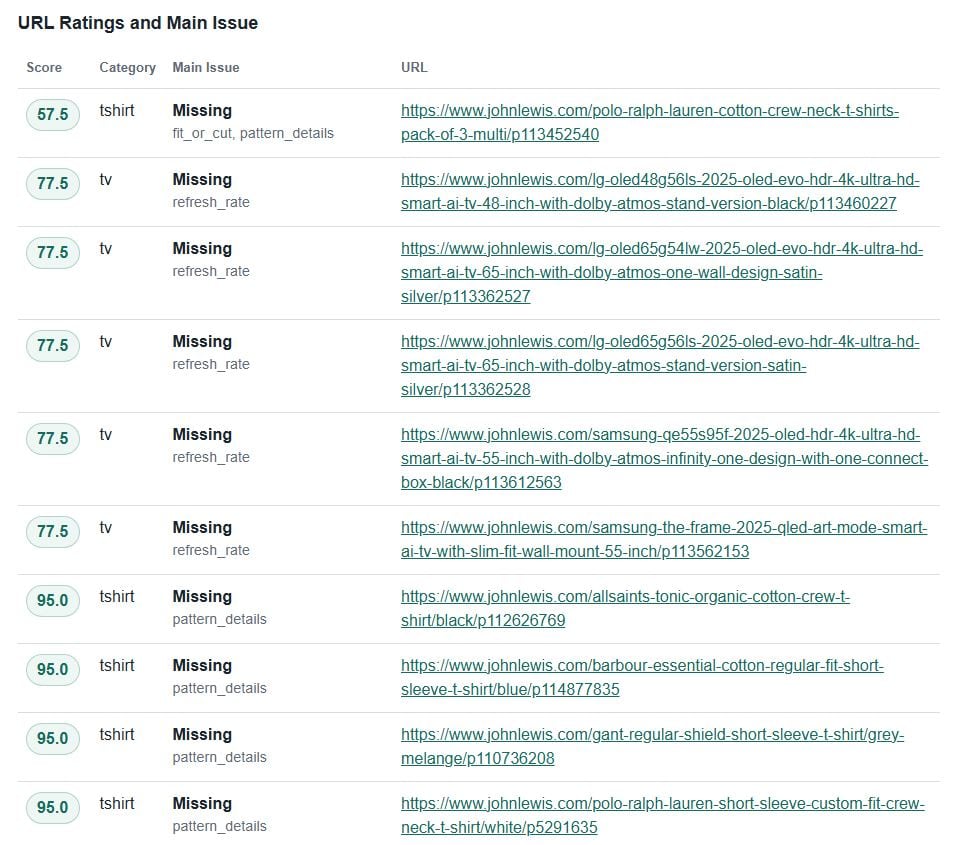
In my case, I integrated the evaluator into my broader SEO toolkit environment so the results could be visualised more easily.
The framework now generates dashboard-style reporting pages that summarise several points.
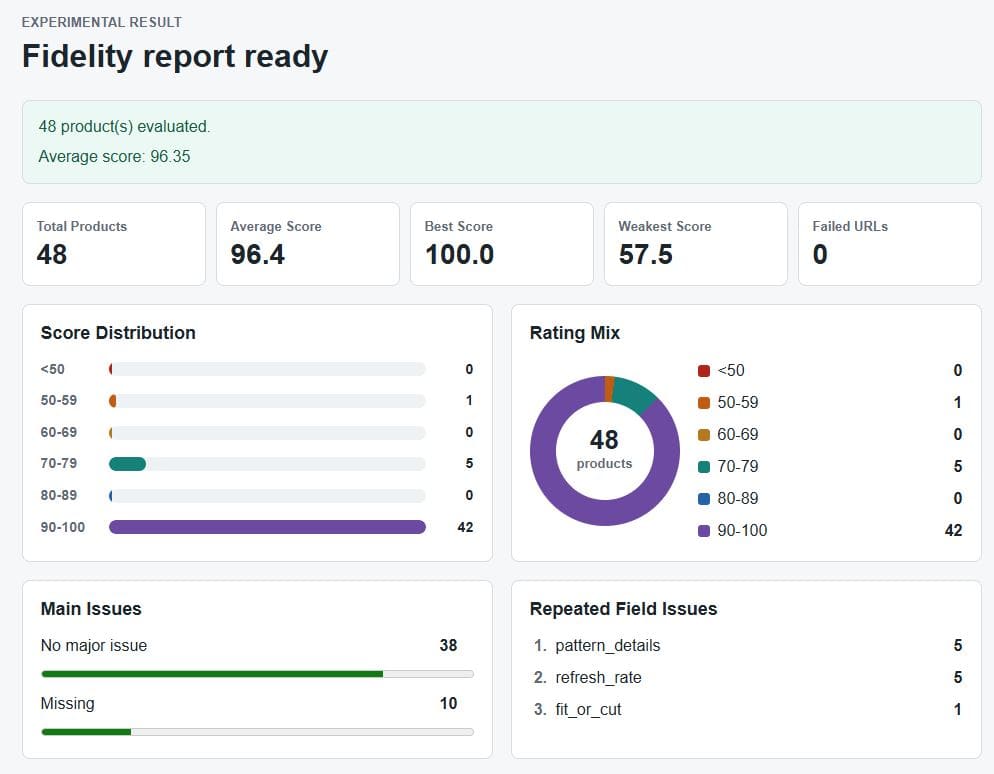
Instead of reviewing raw JSON files manually, the framework can surface patterns across multiple PDPs and categories.
That changes the framework from a technical experiment into something closer to an operational diagnostic layer for ecommerce content quality.
The current system is only one part of a larger possible workflow.
Around the evaluator, additional modules could eventually handle PDP discovery, sitemap crawling, category classification, schema generation, benchmarking, trend monitoring, competitor analysis, and AI readability reporting.
The important part is that the evaluation pipeline itself remains modular.
Limitations
This framework has several important limitations.
First, semantic understanding is approximated through reconstruction fidelity: The framework does not measure true comprehension.
Second, evaluation quality depends heavily on schema quality, category definitions, extraction prompts, and model behaviour.
Third, some product categories naturally expose clearer attributes than others: Technical products with structured specifications are generally easier to evaluate than highly subjective or aesthetic categories.
Finally, different LLMs may produce different extraction behaviour.
The framework is designed to evaluate PDP readability, not establish a universal truth about model capability.
Final Thoughts
Traditional technical SEO focused heavily on crawlability, rendering, structured data, and indexation.
Those things still matter but AI-mediated search introduces a different layer of visibility.
The question increasingly becomes:
Can machines reconstruct the meaning of this product reliably?
Not just:
Can they crawl the page?
Another important aspect of this framework is that it is probably even more relevant for smaller or local AI systems than for frontier commercial models.
Large commercial models such as ChatGPT, Gemini, or Claude are increasingly capable of reconstructing meaning even from messy or poorly structured pages. They can often compensate for weak content structure through scale, training, and inference capabilities.
But many ecommerce platforms are now introducing smaller AI-powered search and recommendation systems directly inside their websites. These local systems are usually far more constrained.
That changes the importance of PDP structure.
If product information is inconsistent, buried in vague copy, fragmented across components, or weakly structured, these smaller AI systems are much more likely to lose important meaning during interpretation.
And increasingly, these internal AI systems may become one of the main discovery layers inside ecommerce sites themselves.
Users may no longer only browse categories or filters. They may ask: Find relaxed fit cotton T-shirts similar to this one.
At that point, the PDP is no longer just a page.
It becomes part of the semantic foundation that powers AI-driven retrieval, recommendation, and product understanding. That means semantic clarity is no longer only an external SEO concern. It also becomes an internal discoverability problem.
This project was an attempt to turn that broader question into something measurable.
Not perfect.
But measurable.
And I suspect this area will become increasingly important as ecommerce discovery shifts toward AI-assisted interpretation and recommendation.